
Is Your Child’s Picture Online? The New AI Threat and Hidden EdTech Dangers Every Parent and School Must Know
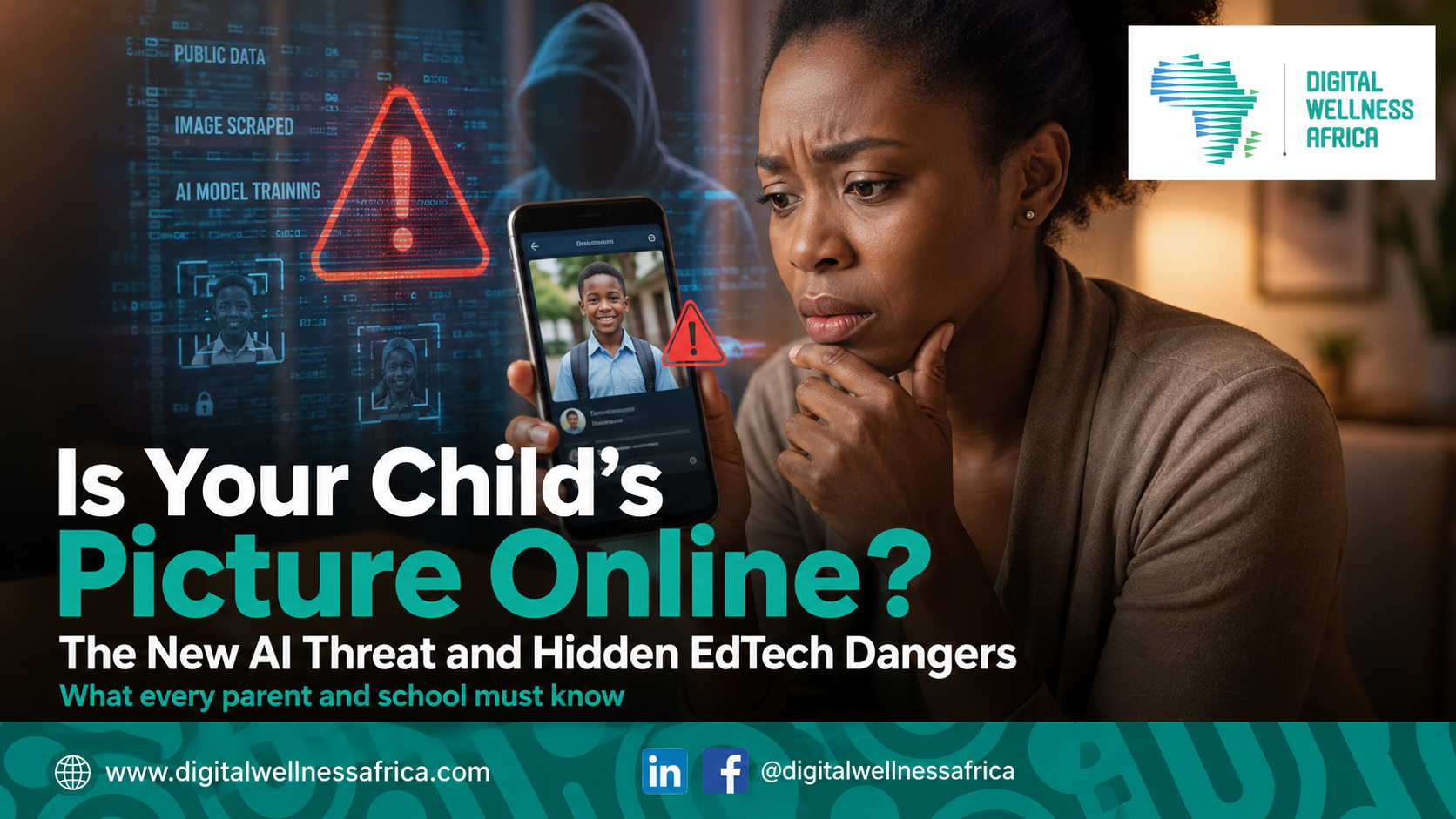
As the new school term kicks off across Zimbabwe and the wider African continent, social media feeds are flooded with joyful images. We see children proudly wearing their new uniforms, walking through school gates, and smiling at their first assemblies.
As parents, it is a moment of immense pride. As schools, it is a powerful marketing tool.
But behind these innocent images lies an escalating digital emergency. In our latest emergency broadcast at Digital Wellness Africa, co-founders Edith Utete and Loveness issued an urgent wake-up call. The traditional ways we handle children's photos and school communications are putting our kids directly in the crosshairs of cybercriminals.
Here is what is happening right now, and why it is no longer business as usual.
How are cybercriminals using AI to target school children?
An emerging, highly dangerous crime wave has crossed over from Europe and the UK, and it is only a matter of time before it becomes widespread in our local communities.
Cybercriminals are now using advanced Artificial Intelligence (AI) tools to harvest public, front-facing photos of children from school websites, Facebook pages, and Instagram accounts. These criminals use AI to manipulate innocent photos, strip the children virtually naked to create explicit imagery, and then target the minors directly for extortion.
The Cycle of AI Exploitation:
The Harvest: Criminals take an image your school or you uploaded. Because of detailed captions, they now know the child's name, school, uniform, and age.
The Threat: They use AI to create a fake explicit image.
The Blackmail: Instead of threatening the school, they bypass adults entirely and target the child directly via social media or chat platforms, demanding money or more photos.
The Emotional Toll: Children targeted by these scams experience deep shame, terror, and isolation. Their first instinct is often to try and solve the problem alone, keeping it secret from their parents out of fear of getting into trouble.
Schools can no longer claim ignorance. If an institution continues to post identifiable front-facing images of children and those images are weaponized by predators, the school risks facing severe legal and moral liability.
Why standard school media consent forms are no longer safe
Many schools defend their social media usage by pointing to signed parental consent forms. But let’s be completely honest: policy compliance is not the same as actual safeguarding.
Most school consent forms are simply tick-boxes to protect the institution. They do not offer true, informed consent. They fail to inform parents why the regulatory framework asks for consent, which is to protect children from identity theft, physical tracking, and AI manipulation. Furthermore, schools remain quiet on retroactivity. If a parent opts out today, what happens to the hundreds of photos of their child uploaded over the last five years?
It is entirely possible to celebrate a school's achievements and market its culture without showing a child's face. It is time for schools to put the best interests of the child ahead of corporate ego.
What are the hidden hazards of using WhatsApp as EdTech?
Since the pandemic, WhatsApp has become the default learning and communication tool for African schools. While it is accessible and affordable, it can become an unregulated, hostile environment for young children without the proper guardrails.
When schools mandate that children join WhatsApp groups for homework, they open a Pandora’s Box of digital hazards.
Unmoderated Group Chaos
Without strict digital guardrails and constant adult moderation, these chat groups quickly morph. We have seen instances where children invite outsiders into class groups, share classmates' phone numbers without permission, or engage in intense peer-to-peer cyberbullying on a platform meant for academics.
Inappropriate Content and Channels
The latest updates from Meta have introduced WhatsApp Channels. Right at the top of the suggested lists, children are frequently exposed to mature, explicit, and highly inappropriate content.
Unregulated AI Companions
With the rollout of Meta AI integrated directly into the chat interface, children are transitioning from using AI for homework to treating it as an AI companion. Children are increasingly being prompted by AI bots to share highly sensitive, personal data about themselves, creating a severe privacy risk.
FAQ: Digital Safety for African Schools and Parents
Is it safe to post pictures of your child online?
No, posting public, front-facing photos of your child online is no longer safe due to the rise of AI face-harvesting tools. Predators use these public images to create deepfake explicit content for extortion. To protect your child, ensure their face, school uniform, and location are not visible to the public.
Why is WhatsApp risky for school homework groups?
WhatsApp is risky for school groups because it lacks child-safety guardrails for minors under the age of 13. Unmoderated school chats expose children to unregulated peer interactions, data scraping via Meta AI, cyberbullying, and inappropriate content found on global WhatsApp Channels.
How can schools market themselves without showing student faces?
Schools can successfully market their achievements by pivoting to creative photography. This includes taking photos from behind the students, blurring facial features, focusing on close-up shots of schoolwork, projects, and trophies, or taking wide-angle group shots where individual children cannot be identified.
Moving Forward: From Compliance to Active Safeguarding
We love technology, and we recognize its power to educate. But in Africa, we do not yet have the sophisticated automated hashing and filtering tools used by Western tech giants to intercept manipulated imagery before it spreads. Our greatest defense is proactive prevention.
What Schools Must Do:
Stop Front-Facing Photography: Pivot to taking photos from behind, focusing on the activity rather than the child’s identifiable facial features.
Upgrade Consent Policies: Transition to true, informed consent forms that educate parents on the real-world digital footprint their children are building.
Appoint Digital Moderators: If you must use WhatsApp for school communications, ensure a trained digital safety policy is enforced, and groups are strictly moderated or locked outside school hours.
What Parents Must Do:
Protect your child’s permanent digital footprint. More importantly, build a relationship of radical trust with your children. Let them know today: "There is no mistake you can make online that cannot be fixed. If something goes wrong, come to me first."
Partner With Digital Wellness Africa
At Digital Wellness Africa, we are actively on the ground helping schools, churches, and families navigate these complex landscapes. We specialize in drafting compliant online protection policies, reforming school social media codes of conduct, and training educators.
We are also excited to announce that we will soon be hosting a Tech Hackathon to bring together software developers, educators, and innovators to build local, African solutions for child online protection.
Let’s put our hands to the plow and protect our children together.
#DigitalWellness #Digital Citizenship #CyberCrime #ChildOnlineProtection #CyberSecurityAfrica #EdTechSafety #ParentingInTheDigitalAge #AISafety #WhatsAppSchoolGroups #DigitalWellnessAfrica #Zimbabwe #EdithUtete #LovenessNleyaCDMP
